
Jacksonville Directory Runs by Year
The Jacksonville Public Library's official preservation material describes a full city directory run beginning in 1870. The endpoint of the printed run has not been verified, so it should not be guessed. Publisher changes matter because geographic reach and indexing practices changed. Webb editions could include communities such as East Jacksonville, Fairfield, Springfield, Hansontown, La Villa, Brooklyn, and Riverside, while later Polk volumes reflect another stage of the city's growth.
| Collection | Years represented | Keeper | Route to access |
|---|---|---|---|
| Early Jacksonville directories | 1870 onward | Main Library Special Collections | Consult the Florida Collection |
| Webb publications | 1876-77, 1878-79, 1882, 1884, 1886-95 | JPL, FamilySearch, Ancestry | Digital, film, or onsite database |
| Vance and Ingram volumes | 1896-1900 | JPL historical run | Special Collections |
| Wiggins directory | 1901 | JPL historical run | Special Collections |
| R. L. Polk era | 1904 onward; documented 1919, 1920, 1926, 1931/32 and later | JPL historical run | Special Collections |
The sequence is broad, but not every edition is equally easy to reach. Ask for a specific year and publisher, especially near a change in compiler. Cite the title page, copyright year, publisher, key, and entry page so another researcher can retrace the work.
Four Jacksonville Directory Publishers
Wanton S. Webb and related Webb imprints dominate the early surviving list. The 1884 volume ranged beyond the core city and even included sketches of Palatka and St. Augustine. Vance Printing issued the 1896 Jacksonville and St. Augustine directory and hotel guide, Hellen K. Ingram published a Webb-titled directory in 1897, and Vance returned for 1899-1900. J. Wiggins & Co. followed in 1901. R. L. Polk & Co. is documented from 1904 onward.
That publisher line is more than bibliography. A missing name may reflect a boundary, canvass, spelling, or editorial change. Search adjacent years and note which neighborhoods the title claims to cover. In 1926, University of North Florida correspondence records a $12 price for one Polk directory, a useful reminder that these were working commercial books, not records created as a complete census.
Open Jacksonville Directories Online
The Jacksonville Public Library digital collection is the first free stop for scanned local material. Its interface lets a researcher inspect images rather than rely only on OCR, which often mangles initials, abbreviations, and old type. The FamilySearch catalog record identifies filmed Jacksonville directories, including films for Webb's 1888-95 run. Some images may require a FamilySearch Affiliate Library computer.
The library also provides Ancestry Library Edition onsite and HeritageQuest access. Ancestry's Webb 1888-93 database covers six volumes and reports more than 70,300 names. It supports searches by name, year, keyword, occupation, comments, business, and residence year. Use the database to find a page, then read the scan.
See the digitized Jacksonville materials before planning a visit.
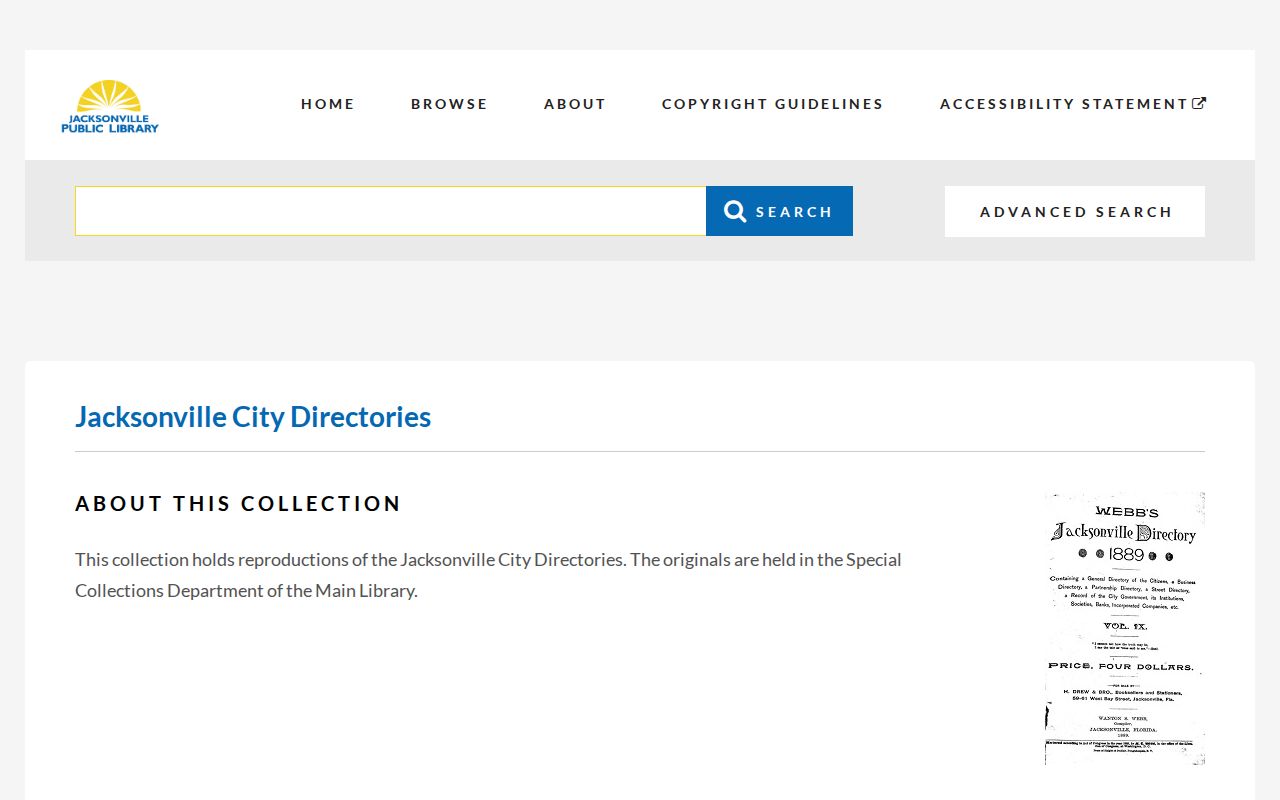
The captured collection screen shows the library-hosted route that can move a city directory search from a catalog clue to a page image.
Decode a Jacksonville Directory Entry
A Webb-era line may include a surname, given name or initials, spouse marker, occupation or employer, business address, and home address. Symbols such as h or r can mark a home or residence. Widowhood and household-head notes may connect family members. Segregated-era editions may also use race labels, which must be read in their historical context and checked against community sources.
| Name form | Surname, first name or initials; a spouse may appear in parentheses. |
|---|---|
| Work detail | Occupation, employer, or separate business address. |
| Home line | House number and street, with volume-specific shorthand. |
| Household note | Widow, boarder, or householder notation where the edition uses it. |
| Street listing | Occupants grouped by numbered address in later street sections. |
- Criss-cross directory
- A later directory arranged by street and house number instead of surname.
- Householder index
- A listing centered on named household heads, which can omit other people at the address.
- Abbreviation key
- The volume's own legend for marks and shortened words; save it with every entry.
Jacksonville Names Meet Street Numbers
Alphabetical pages answer where a named person was listed. Street sections reverse the path: find a street, move to a house number, and read the named occupant. This is valuable when initials vary or two residents share a surname. It also exposes nearby households that may be relatives, coworkers, or unrelated neighbors.
Renumbering complicates the search. Some volumes print old and new numbers together. When they do not, compare the same occupant, cross streets, legal description, and neighboring names across editions. The Jacksonville street directory handles modern parcel and address tools; historical directory street pages belong here.
Note: A directory listing is evidence of a canvassed address, not proof that every household member was recorded.
Trace Jacksonville Families Between Censuses
Federal census schedules through 1950 are public under the 72-year rule, while the 1960 census is scheduled for release in 2032. Jacksonville city directories bridge years between those snapshots and help compensate for the destroyed 1890 population schedules.
- Find the earliest likely alphabetical entry and transcribe it exactly.
- Move one edition at a time, recording home, work, spouse, and spelling changes.
- Switch to the street section and note the names at nearby numbers.
- Pair the trail with the nearest public census, deed, probate, permit, or newspaper page.
- Test a disappearance in later editions before treating it as a move or death.
Occupation and employer continuity can separate people with identical names. Absence in one year may mean a missed canvass, marriage, name change, travel, death, or timing. Confirm the explanation elsewhere.
Test Jacksonville Addresses on Maps
The historical study for 830 Houston Street shows the method in practice. Investigators found Oscar Neunert in directory construction listings from the 1880s through 1904, then compared that trail with the building's presence on a 1903 Sanborn map and absence from the 1897 sheet. Library of Congress Sanborn maps cover Jacksonville years including 1884, 1887, 1891, 1897, 1903, 1913, 1924, and 1949.
Map paste-overs can hide an earlier footprint, so compare an uncorrected sheet when possible. Newspaper evidence adds another layer. JPL's NewsBank access covers the Florida Times-Union from 1883, the Jacksonville Journal from 1901 through 1988, and the Beaches Leader from 1963. Search name variants and the address without a ZIP, then inspect the original page for OCR errors.
Visit Jacksonville Special Collections
Main Library Special Collections holds the Florida Collection, Duval probate sources, more than 2,000 family and county histories, expanding school and college yearbooks, and 372 city ledgers and documents from the 1870s through the 1960s. Its Times-Union morgue exceeds 130,000 clipping and photo files and is distinct from full-text newspaper search.
Call 904-255-2665 before visiting 303 N. Laura Street. Give staff the surname, address, decade, and target directory years. A scheduled genealogy consultation can surface material that is not fully cataloged online. The library's Memory Lab also lets families digitize photographs, paper documents, film, and audio at no charge.
The State Library and Archives city directory guide gives a second route to Florida holdings.
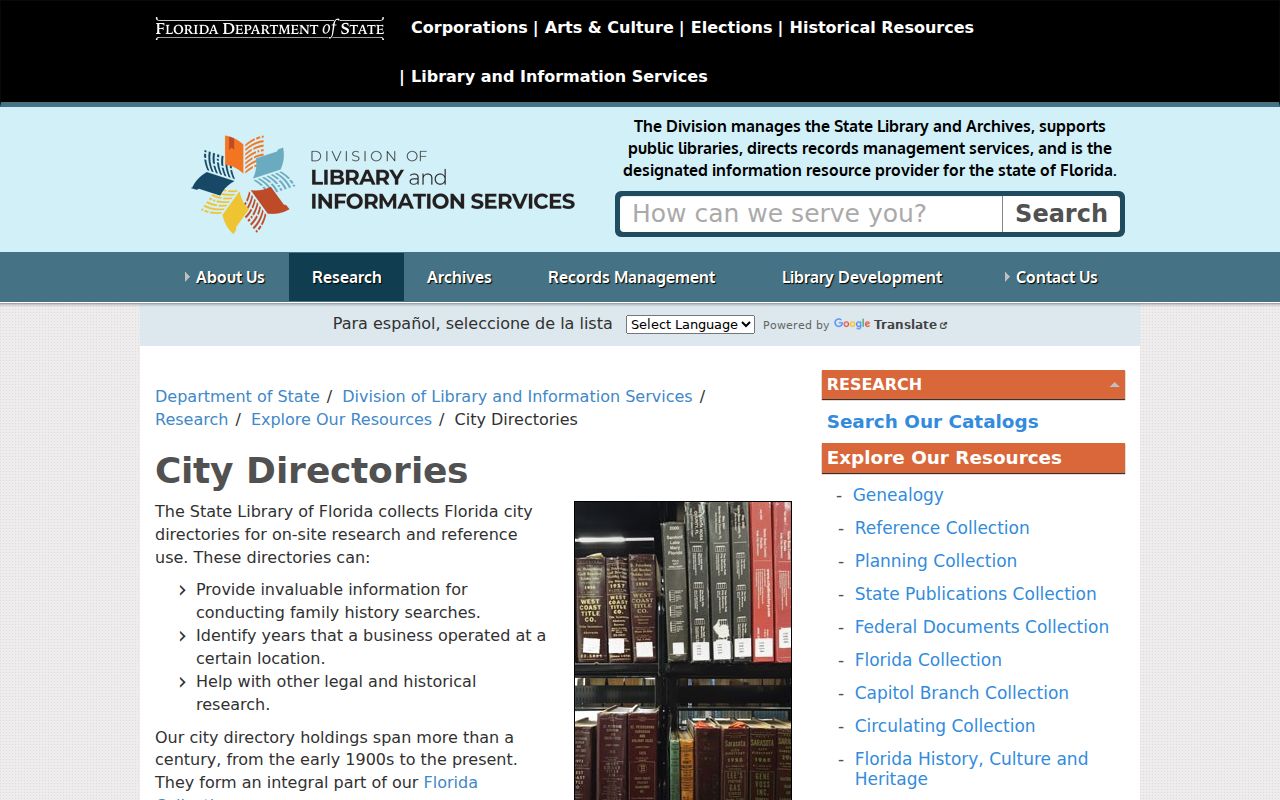
The state guide helps distinguish a cataloged directory from an online scan and can point toward another holding when a Jacksonville year is not digital.
Restore Missing Jacksonville Community Stories
Commercial directories were shaped by their era. Jacksonville's African American Digital Community Archive adds funeral programs, family Bibles, church records, and civic papers that can restore ties missing or distorted in segregated listings, especially around LaVilla. Yearbooks can confirm school-year affiliation and name spelling, though they do not prove a current address.
The Jacksonville Historical Society preserves more than 200 years of material, over 2,000 linear feet, and roughly 100,000 photographs. Its Jacksonville History Center at 314 Palmetto Street accepts research requests; a normal response may take up to three weeks. Personal appointments are free, while scanning and publication fees should be confirmed first.
A searchable reproduction of the Webb years offers another image-based view of the collection.
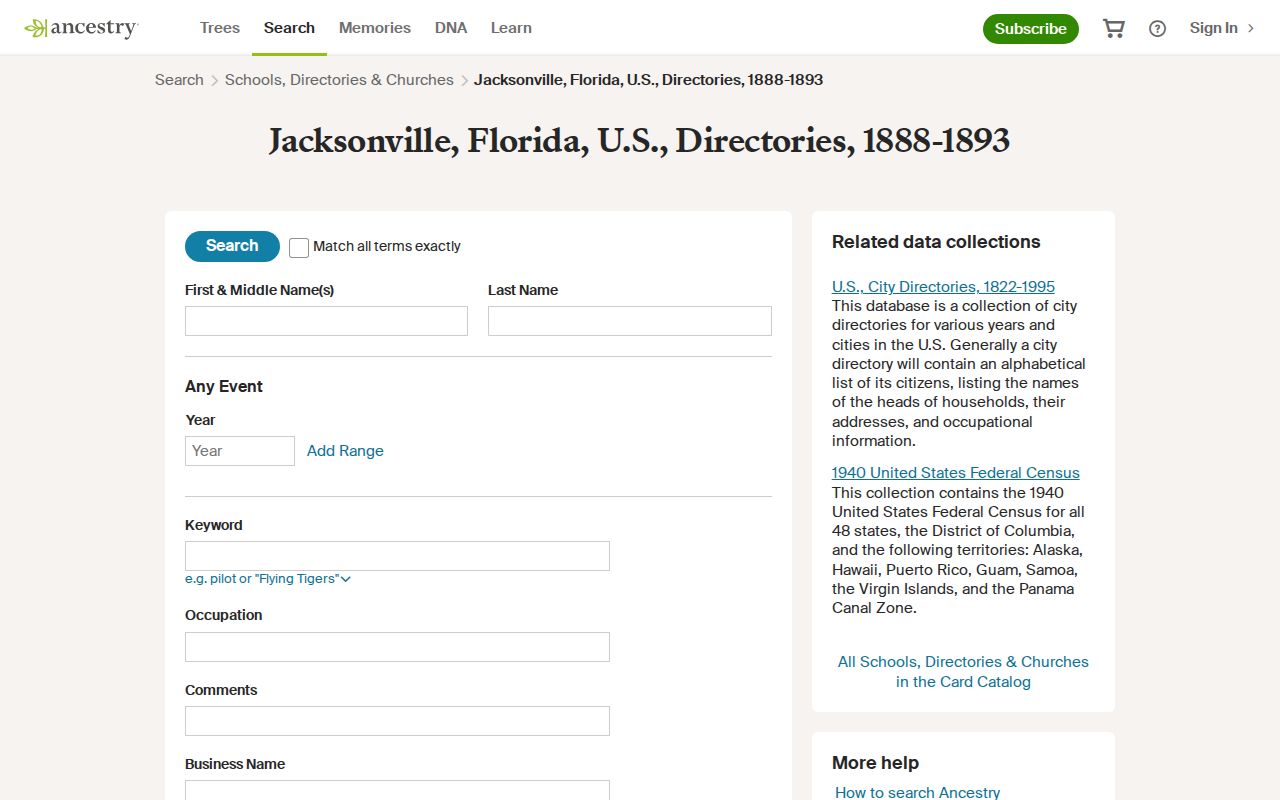
That database is best treated as an index into the original volumes, not a substitute for the printed page and its key.
Directories Survived Jacksonville Record Loss
Civil War disruption and the Great Fire of May 3, 1901 caused broad losses in Jacksonville's official trail. City directories can become substitute evidence when an expected municipal or county file no longer exists. Their annual rhythm can place a household close to an event even when the deed, permit, or administrative record is gone.
They are not perfect replacements. A directory publisher gathered commercial data, not sworn testimony. Pair an entry with a census, newspaper, probate record, Sanborn sheet, church source, or surviving deed. Agreement among independent records is what turns one old listing into a sound family or address history.
Government ledgers at Jacksonville Public Library offer another check when a name appears in civic life rather than a household listing. The Special Collections shelf includes 372 ledgers and documents covering council and commission minutes, ordinances, resolutions, and indexes from the 1870s into the 1960s. These volumes may name officials, petitioners, or people tied to a property proceeding. Cite the governing body, volume, date, and page. A civic entry does not prove a home address, but it can explain why a resident appears between directory years or link an abbreviated directory name to a fuller public record.