
Jacksonville Address History Sources
No single roll lists all previous residents of a Jacksonville address. The current parcel card is the best starting point because its RE number, legal description, sale book and page keep the property identifiable when a street name or number fails. Acclaim carries the modern recorded-document chain. City directories and census schedules add people who occupied the home but never held title. Permits and Sanborn fire-insurance maps date changes to the building itself.
| Source | Years It Covers | Where Held | What It Shows |
|---|---|---|---|
| Acclaim Official Records | 1988 to present | Duval County Clerk online | Title parties, dates, book/page, images |
| Jacksonville city directories | 1870 onward | JPL Special Collections and digital collection | Named occupants, work, and street listings |
| Federal census | Public through 1950 | NARA and library databases | Enumerated households and relationships |
| Old-city permits | 1904 onward | JAXEPICS and older film | Applicant, site, work, builder or architect |
| Sanborn maps | 1884 through later editions | Library of Congress and local collections | Footprint, use, material, and address context |
For a recent transfer, start online with the parcel card and deed image. For an early twentieth-century household, start with the directory street section, then pair that entry with a census and map. The Jacksonville Public Library collection reaches back to 1870, but the final printed year was not established in the research. Treat that endpoint as unknown rather than filling it in.
Walk Jacksonville Deeds Backward
The deed chain traces ownership, not every occupant. Open the Duval County Property Appraiser search and copy the RE number, current owner, situs address, legal description, and newest sale book/page. The situs is the physical parcel address; the mailing address is where tax mail goes. Their match may support owner occupancy, especially with a homestead entry, but it is not a household roster.
- Find the present parcel and save its RE number, legal description, and latest Official Record book/page.
- Open that instrument in Acclaim. Confirm that the legal description matches before accepting the name.
- Identify the seller, or grantor, then search that person as an earlier buyer, or grantee. Match book/page and land description at each link.
- Repeat to the 1988 online boundary. Do not treat a low-price or unqualified transfer as a normal market sale without reading the deed.
- Carry the last book/page lead to the Clerk's Room 1253 for older books or film. Staff, mail, and in-person requests bridge the web cutoff.
- Grantor and grantee
- The grantor gives an interest in land; the grantee receives it.
- Chain of title
- The linked sequence of recorded transfers for the same parcel.
- Legal description
- The lot, block, subdivision, or metes-and-bounds text that identifies land even when its street number changes.
Jacksonville Parcel Leads Cross 1988
The Property Appraiser's sales history can point farther back than Clerk web images. The inspected City Hall parcel, RE 073768-1000, displays a 1986 book/page lead even though Acclaim coverage begins in 1988. That is a useful local shortcut: preserve every older book/page printed on the parcel card, then give it to Clerk staff rather than attempting a blind name search across shelves.
The sample parcel page shows how much context can survive in one card: owner and mailing address, Primary Site Address, legal description, subdivision, historic designation, building details, value summaries, exemptions, and a sales table. It also shows why values must be read with care. An assessed value is not a sale price, and a qualified-sale flag is only a clue until the deed is checked.
See the inspected City Hall parcel record for the layout used to anchor previous-resident research.
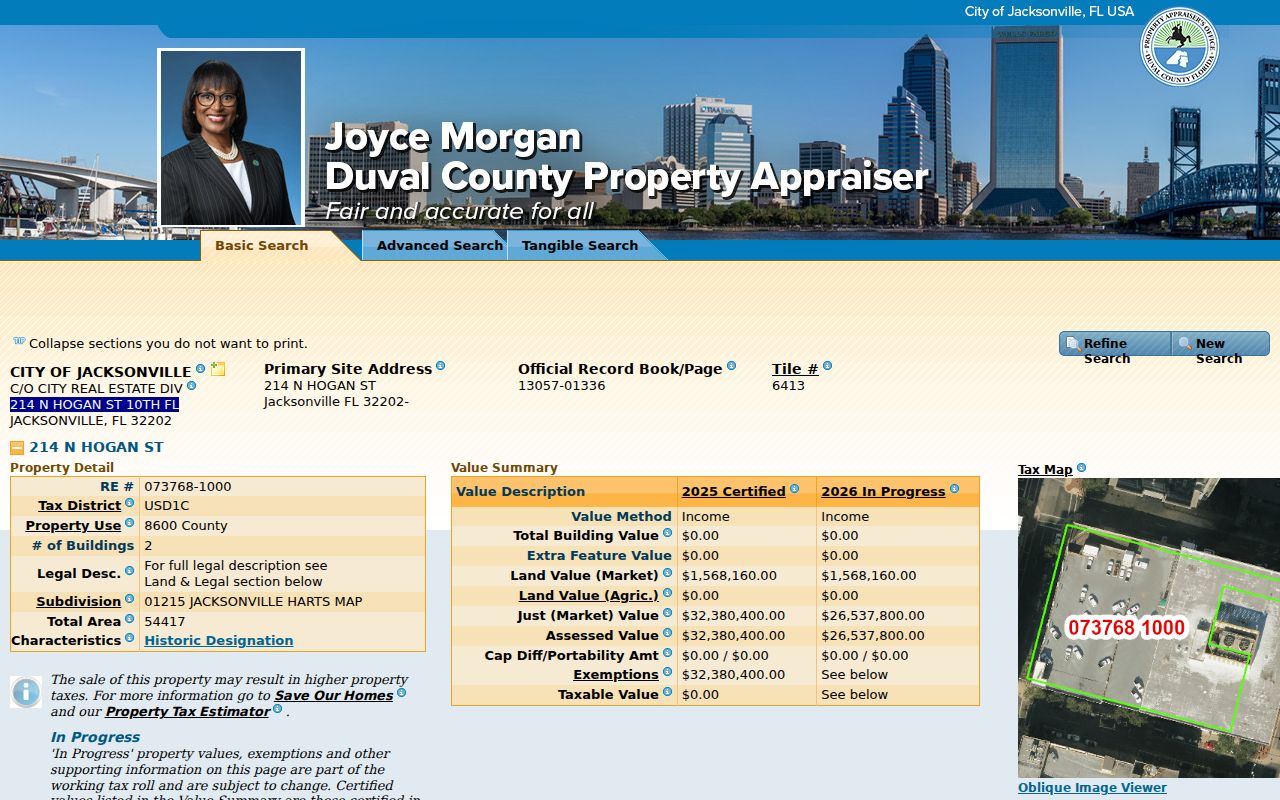
The visible sales and legal fields demonstrate how a current card supplies the fixed identifiers needed for older courthouse research.
Older Duval Records at the Counter
Acclaim offers free uncertified images from 1988 forward, but an empty web result does not end a Jacksonville trail. Official Records and Research is in Room 1253 at 501 W. Adams Street. It is open Monday through Friday, 8 a.m. to 5 p.m., and the number is 904-255-2025. A request should include exact party spellings, an approximate date, document type, subdivision or legal description, and any book/page found in the parcel roll.
Staff can retrieve earlier books and film for inspection or copies. Office copies cost $1 per page. A mailed paper return needs a self-addressed stamped envelope and an accepted certified form of payment, not a personal check. Ask for an uncertified research copy unless authenticated evidence is truly needed. Online eCertification adds the statutory certification and vendor charges documented by the Clerk.
Local shortcut. A parcel-card book/page can cross the online cutoff with far less ambiguity than a common surname.
Filter Jacksonville Sales Carefully
The Duval property sales search narrows transfers by date, price, qualified status, vacant or improved status, subdivision, ZIP, property use, homestead, value, acreage, heated area, and year built. It is useful when a book/page is missing or when several same-name owners appear. Multiple ZIP codes must be entered with commas and no spaces.
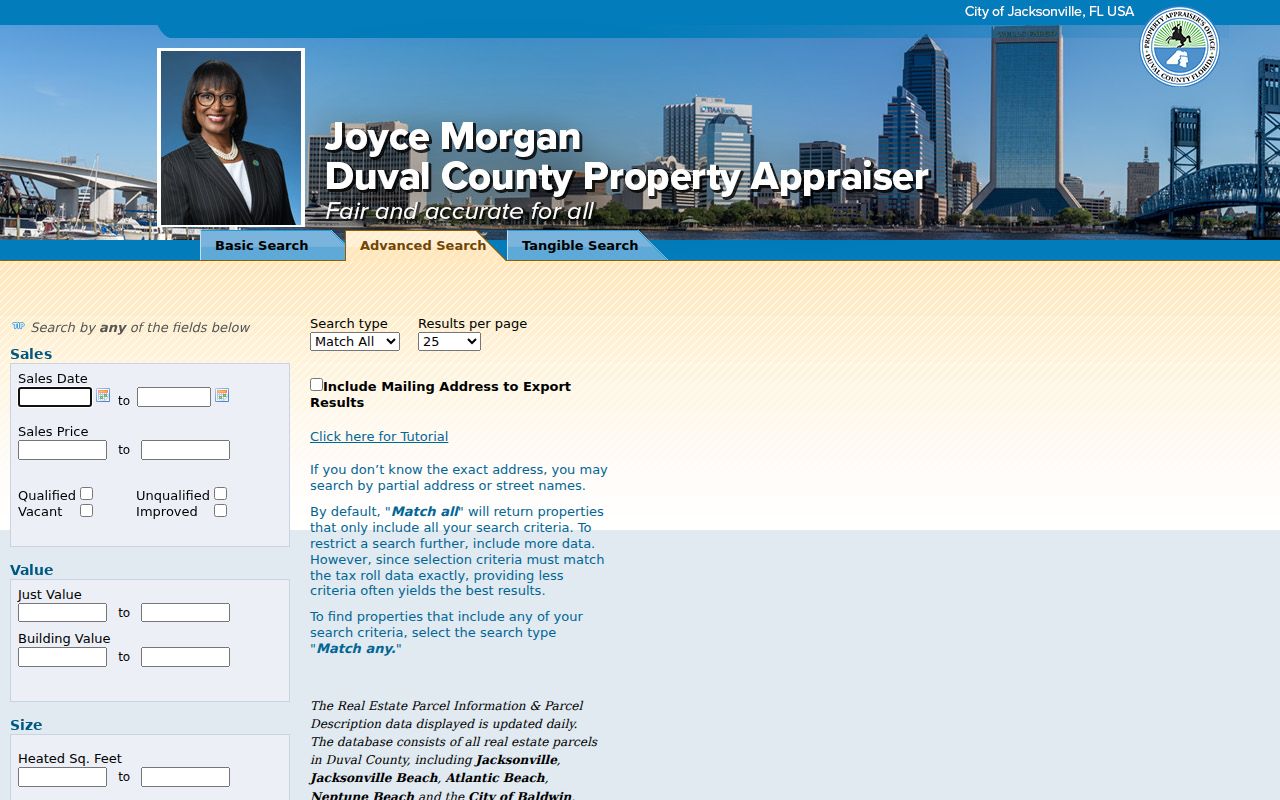
The filters narrow a candidate set, but the deed and legal description remain the proof that two sales concern the same land.
A nominal or unqualified transfer may reflect family, government, affiliate, or partial-interest activity. Do not infer that a former owner moved away, or that the price reflects the whole property, from the sales grid alone. The recorded image can reveal marital language, return-to addresses, related instruments, and party roles that the result row omits.
Jacksonville Permits Date the House
Old-city permit film begins in 1904. A card may state the year, applicant, general or legal location, physical description, and, in later records, the builder or architect. Pre-consolidation county building records were lost, so an address now called Jacksonville may have a different record trail depending on whether it sat in the old city. A permit applicant or contractor is not automatically a resident.
Sanborn sheets add the building's footprint, use, construction material, and address context for 1884, 1887, 1891, 1897, 1903, 1913, 1924, 1949, and later coverage. Begin with an uncorrected sheet where available. Paste-over updates can hide the first footprint, and comparing only the latest layer can make an older structure seem to vanish.
This gap is a Jacksonville quirk with real consequences. The 1968 consolidation joined most city and county government but left the Beaches and Baldwin separate. Match the parcel's former jurisdiction before deciding which permit series should exist.
Why Jacksonville Trails Break
Duval County dates to 1822, the year Jacksonville was platted, yet age alone does not promise a complete file. T. Frederick Davis reported wholesale official-record loss during the Civil War and the Great Fire of May 3, 1901. Researchers must often rebuild a life from sources that survived outside the damaged official series.
Directories, deeds, newspapers, maps, probate, tax material, and permits should be treated as complementary evidence. A missing directory entry can reflect a skipped canvass, brief absence, name change, move, death, or publication timing. It is not proof that no one lived at the house. The city's segregated record history also makes community archives vital when official and commercial sources omit or distort Black Jacksonville lives.
Map Jacksonville Previous Residents
Sanborn fire-insurance maps do not name every past resident, but they help prove that the address and structure existed in the form a directory describes. Compare the building footprint, construction material, street number, use, and nearby landmarks across local map years. An address absent from one sheet may lie beyond that edition's mapped area rather than on an empty lot.
Pair the map with a Jacksonville directory from the same period. If the number changes, match the occupant, cross streets, and lot or block description before moving the earlier entry forward. This is stronger than assuming that two similar numbers refer to the same house.
Jacksonville Previous Residents in Archives
When public portals end, call JPL Special Collections with the surname, address, decade, and directory years needed. Staff can point to directory images, probate holdings, yearbooks, newspapers, and sources not fully cataloged online. Photograph or cite the title page, publisher, year, abbreviation key, and entry page so another researcher can follow the same trail.
The Jacksonville History Center at 314 Palmetto Street accepts research requests by collection, person or business, and date span. Its archives cover more than 200 years. Personal and family research appointments are free, while document scans are listed at $3 per page plus labor and images at $7 plus labor. Confirm charges before ordering.
Jacksonville Previous Residents by Household
Owners are only half the story. Jacksonville directory street sections arrange numbered addresses and identify occupants, while alphabetical entries can add work, spouse, and home notations. The local run begins in 1870. These entries often supply the best named evidence for previous residents who never held title. The collections and publisher changes are covered on the Jacksonville city directory page; for an address trail, transcribe the entry and the neighboring numbers instead of rebuilding the whole shelf history.
- Find the address in a directory street section and copy the exact occupant spelling, number, publisher, year, and abbreviation key.
- Check the year before and after. Track the same person through work, spouse, relatives, and nearby house numbers.
- Pair the result with the closest public federal census, available through 1950 under the 72-year rule.
- Use a legal description, cross streets, occupant continuity, or an old-and-new number table when the address changes.
- Close a deceased resident's trail through probate, an obituary, cemetery evidence, or newspaper notices without guessing where a seller moved.
Jacksonville Public Library Special Collections holds the Florida Collection, Duval probate, expanding yearbooks, more than 2,000 local histories, and a Times-Union morgue exceeding 130,000 files. The Jacksonville History Center holds more than 2,000 linear feet and 100,000 photographs. Its stated response time is usually within three weeks; appointments and personal research are free, while scans and publication work may cost more.
Lawful use. Trace previous residents for house history, family history, and personal research. Never use an address trail to stalk, harass, intimidate, or harm a living person.